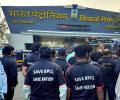
Privatisation of BPCL, which was dubbed India's biggest ever, has been stalled with just one bidder left in the fray after two others walked out over issues such as lack of clarity in fuel pricing, a top source said. The government had planned to sell its entire 52.98 per cent stake in Bharat Petroleum Corporation Ltd (BPCL) and invited Expression of Interest from bidders in March 2020. At least three bids came in by November 2020 but only one remains now after the others withdrew from the race.
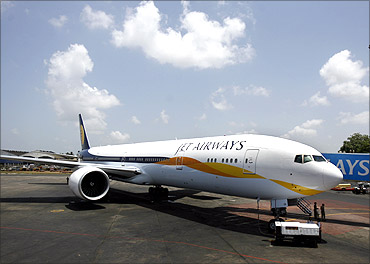
Jet fuel constitutes over 40 per cent of an airline's operating costs and the price cut will bring relief to the cash-strapped carriers.
If cleared, the ONGC arm will become the first subsidiary company of an existing Maharatna to get into this superior league among government-owned entities.
Aramco also plans to invest in building India's largest oil refinery on the country's west coast.
The government cleared the proposal despite opposition from the petroleum ministry, which says this is not the right time for divestment as the sector is moving from trade parity to export parity pricing.

The government allocated Rs 650 billion for petroleum subsidies in FY14, of which Rs 450 billion was used to pay oil marketing companies for the subsidy gap incurred in the previous financial year.
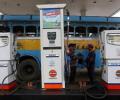
Movement of prices in international oil market and rupee-USD exchange rate will be monitored
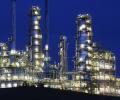
BPCL's impending privatisation and RIL's stake sale to Saudi Aramco raise questions about the future of the West Coast Refinery, once touted as the world's largest.
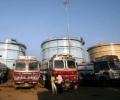
The tankers carrying fuel from terminals to dealer outlets would not just have global positioning system (GPS) tracking but also an electronic key (e-key).

Oil prices jumped nearly $3 a barrel and gold and safe-haven bonds rallied on Friday after the killing of top Iranian commander Qassem Soleimani in an airstrike by the US in Baghdad.
Aviation turbine fuel to now cost more.
Upstream firms have a tremendous financial pressure due to selling crude at subsidised rates to oil marketing firms.

Re-rating of Bharat Petroleum Corporation, Container Corporation, Shipping Corporation, SAIL, and Hindustan Copper, for which the government has already shown intent to divest its stake, possible now, say analysts.

Petrol and diesel are among the 90-plus commodities that have been approved by the government for derivatives trading

Dealers are not happy with the company's latest retailing policy and decided not to re-open their pumps.

According to data shared with the Lok Sabha, 19 road projects awarded after May 2014 were facing delays

The Indian basket represents the price of Oman and Dubai sour grade crude.

Essar Oil has decided to cut petrol and diesel prices in the range 50 paise to Rs 2.50 per litre effective from July 16.
State-run Bharat Petroleum Corp Ltd on Wednesday said it has tied up with Hindustan Lever Ltd and three other kitchenware brands for selling grocery items to its LPG customers through its distributor network.\n\n\n\n

In Mumbai, jet fuel costs Rs 71,940.36 per kl as against Rs 73,306.89 per kl previously, IOC said.
The government has asked Supreme Court not to stay the privatisation of public sector oil majors -- Hindustan Petroleun Corporation and Bharat Petroleum Corporation

Aviation Turbine Fuel, or ATF, price at Delhi was cut by Rs 3,025.34 per kilolitre, or 4 per cent, to Rs 71,800.21 per kl, according to Indian Oil Corp, the nation's largest fuel retailer.
India's fuel consumption slumped by over 66 per cent in the first week of April as a nationwide lockdown halted economic activity and travel, which eviscerated demand. Petrol and diesel demand is down 66 per cent in April, while aviation turbine fuel (ATF) consumption has collapsed by 90 per cent as most airlines have stopped flying, industry officials said.

The loss on diesel sales has inched up marginally to Rs 8.37 a litre even as a surge in international oil rates and a weakening rupee wiped out gains from a 50 paise increase in the price of the fuel.
On October 31, the government exempted jet fuel from 5 per cent import duty. Indian Oil, Bharat Petroleum and Hindustan Petroleum cut jet fuel or aviation turbine fuel price from November 1 in Delhi by Rs 9,429.87 per kl to Rs 47,017.93 per kl, in line with fall in international oil prices.
The government has ordered Oil and Natural Gas Corp (ONGC) to pay a near-record Rs 13,764 crore as fuel subsidy for the December quarter, a move that will dent the firm's profitability.
This is the second straight increase in ATF price this month. Rates were hiked by a record 56.5 per cent (Rs 12,126.75 per kl) on June 1. Simultaneously, petrol and diesel prices were hiked for the 10th day in a row.
International oil prices have hit a six-month low, helping Indian fuel retailers breakeven on petrol but they continue to lose money on diesel - the most used fuel in the country, officials said. The world's best-known crude benchmark, Brent was trading at $94.91 per barrel on Thursday after concerns of a global recession led to it slipping to a six-month low of $91.51 on the previous day. The current rates are a relief to India, which is 85 per cent dependent on imports for meeting its oil needs.
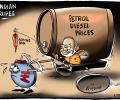
On Tuesday, Petroleum Minister Dharmendra Pradhan met Russian oil giant Rosneft's chief executive officer Igor Sechin and discussed raising crude imports from that country, in addition to talks about going for more acquisitions.

The market breadth, indicating the overall health of the market was strong
While LPG price was raised by Rs 18, kerosene saw a hike of Rs 3 per litre

Petrol prices were on Wednesday hiked by Rs 3.07.

Oil companies on Monday slashed petrol price by Rs 3.02 per litre.
Fuel rates were last revised on February 1 when petrol price was cut by a marginal 4 paise a litre.

Oil imports are a third of India's total import bill.

One of the reasons is that the retail prices are not bench-marked to crude but their respective international benchmark prices.

The ethanol vehicles will have the flexibility to switch to other fuels

Govt's move will facilitate entry of global giants such as Total SA of France, Saudi Arabia's Aramco, BP Plc of the UK, and Trafigura's downstream arm Puma Energy.

Fernandes wanted Coca-Cola Company to not just transfer 60 per cent of the shares of its Indian firm but also the formula for its concentrate to Indian shareholders.
Petrol and diesel price hikes are likely to resume after state elections get over next week to bridge the Rs 9 a litre gap created by international oil prices soaring past $100 a barrel. International crude oil prices shot above $110 a barrel for the first time since mid-2014 on fears that oil and gas supplies from energy giant Russia could be disrupted, either by the conflict in Ukraine or retaliatory western sanctions. The basket of crude oil India buys rose above $102 per barrel on March 1, the highest since August 2014, according to information from the Petroleum Planning and Analysis Cell (PPAC) of the oil ministry.
